Abstract

Hand avatar reconstruction typically relies on multi-view capture or per-subject optimization, limiting its scalability. We introduce InstantHand, a feed-forward framework that constructs an animatable 3D Gaussian hand avatar from a single image using off-the-shelf MANO, camera, and mask estimates, without test-time optimization. To address alpha leakage that thickens thin finger contours yet is barely penalized by image-averaged losses, we propose a Soft Alpha Band regularizer that focuses supervision on silhouette boundaries. Moreover, because colors regressed from image features drift toward a learned prior even in observed regions, we introduce Reliability-gated Appearance Transfer, which carries over observed appearance from the input based on each Gaussian's rendering contribution and completes unobserved regions with the learned prior and a global source identity. InstantHand constructs an avatar in 2.84 seconds and renders at 161 FPS. It matches per-subject-optimized baselines on InterHand2.6M and remains competitive in zero-shot evaluation on HanCo.
Results
Avatars from a single image
- 360° views: InterHand2.6M and HanCo (zero-shot) subjects with the benchmark MANO, camera, and mask; ARCTIC and an in-the-wild image with estimated ones.
- Animation: eight subjects outside the training data, built with a SAM 3 mask and WiLoR MANO and camera, with no ground-truth annotations.
- With fully estimated inputs, PSNR on InterHand2.6M drops by only 0.22 dB (26.21 to 25.99 dB).
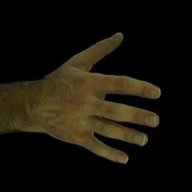
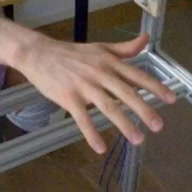
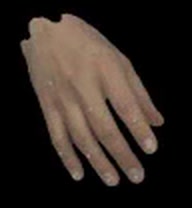
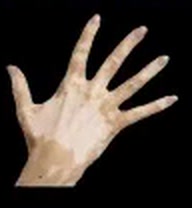
360° views of the canonical avatars. The side hidden in the input is completed by the model.
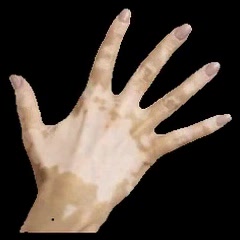
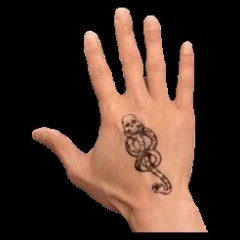
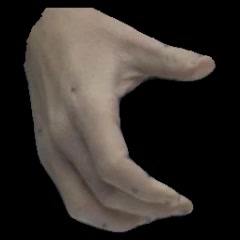
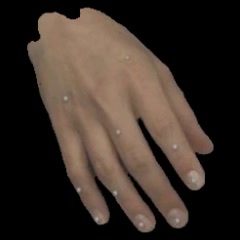
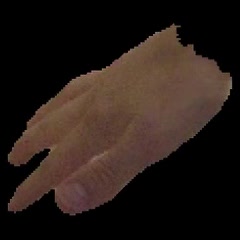
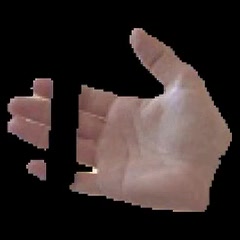
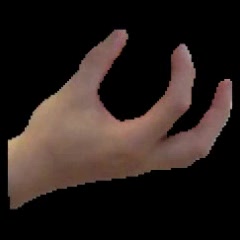
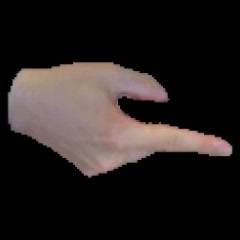
Animation with a shared MANO pose sequence.
Comparison to per-subject optimization
- On InterHand2.6M, InstantHand reaches 26.21 dB PSNR without any fitting, against 26.11 dB for the best per-subject-optimized method.
- On HanCo, applied zero-shot, it reaches 20.18 dB against 20.32 dB for the best fitted baseline, at over 400× lower avatar-acquisition cost.
HanCo sequence, same source frame and inputs for every method. Times are per-subject avatar-acquisition costs. BIGS*: our single-hand adaptation of BIGS.
Video
Method
Architecture
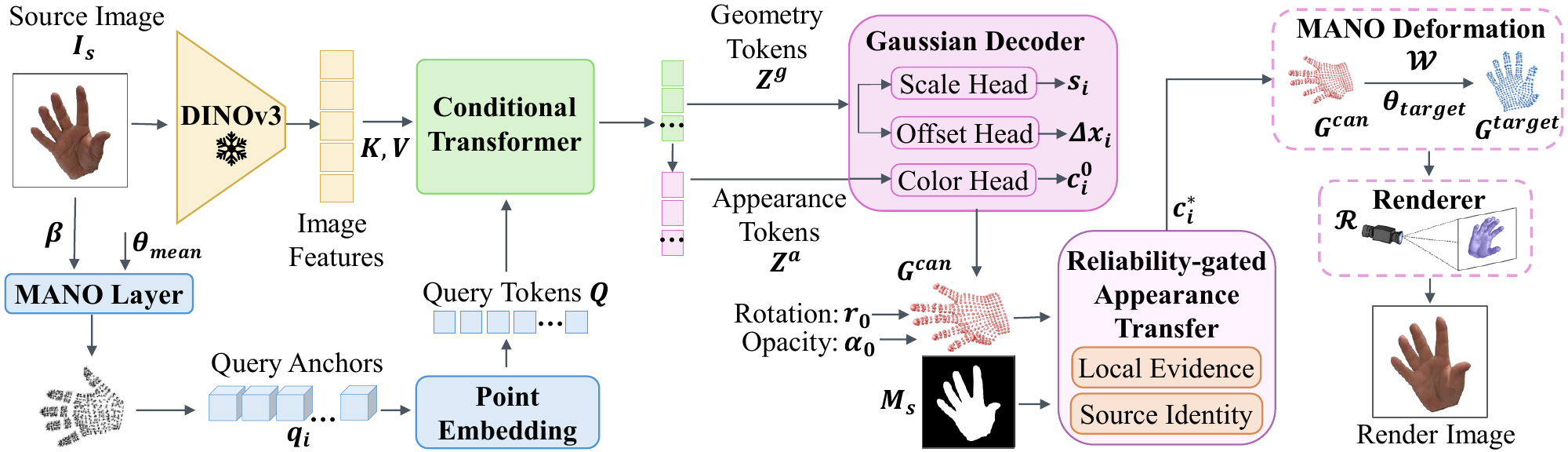
- A conditional transformer fuses frozen DINOv3 image features with query tokens anchored on the MANO surface and decodes them into a canonical Gaussian hand in one forward pass.
- Gaussians keep a fixed rotation and opacity; only surface offsets, scales, and colors are predicted.
- The avatar is animated by MANO skinning and rendered at 161 FPS; no network runs at animation time.
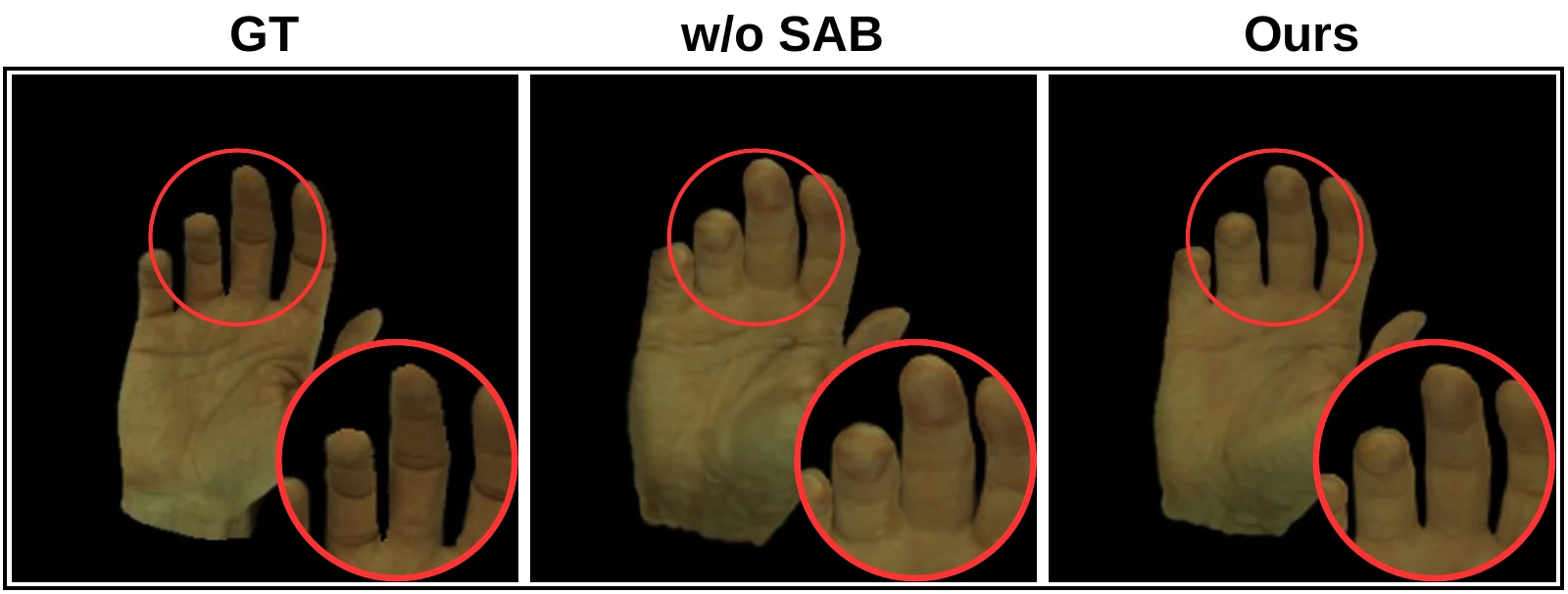
Soft Alpha Band
- Fingers are thin, and losses averaged over the full image barely penalize alpha that leaks past them, so contours thicken.
- The Soft Alpha Band supervises rendered alpha only around the silhouette, penalizing leakage in an outer band and missing alpha in the eroded interior.
- It raises the boundary F-score from 0.366 to 0.698. Head (LAM) and body (LHM) recipes ported to MANO under matched training reach 0.299 and 0.267.
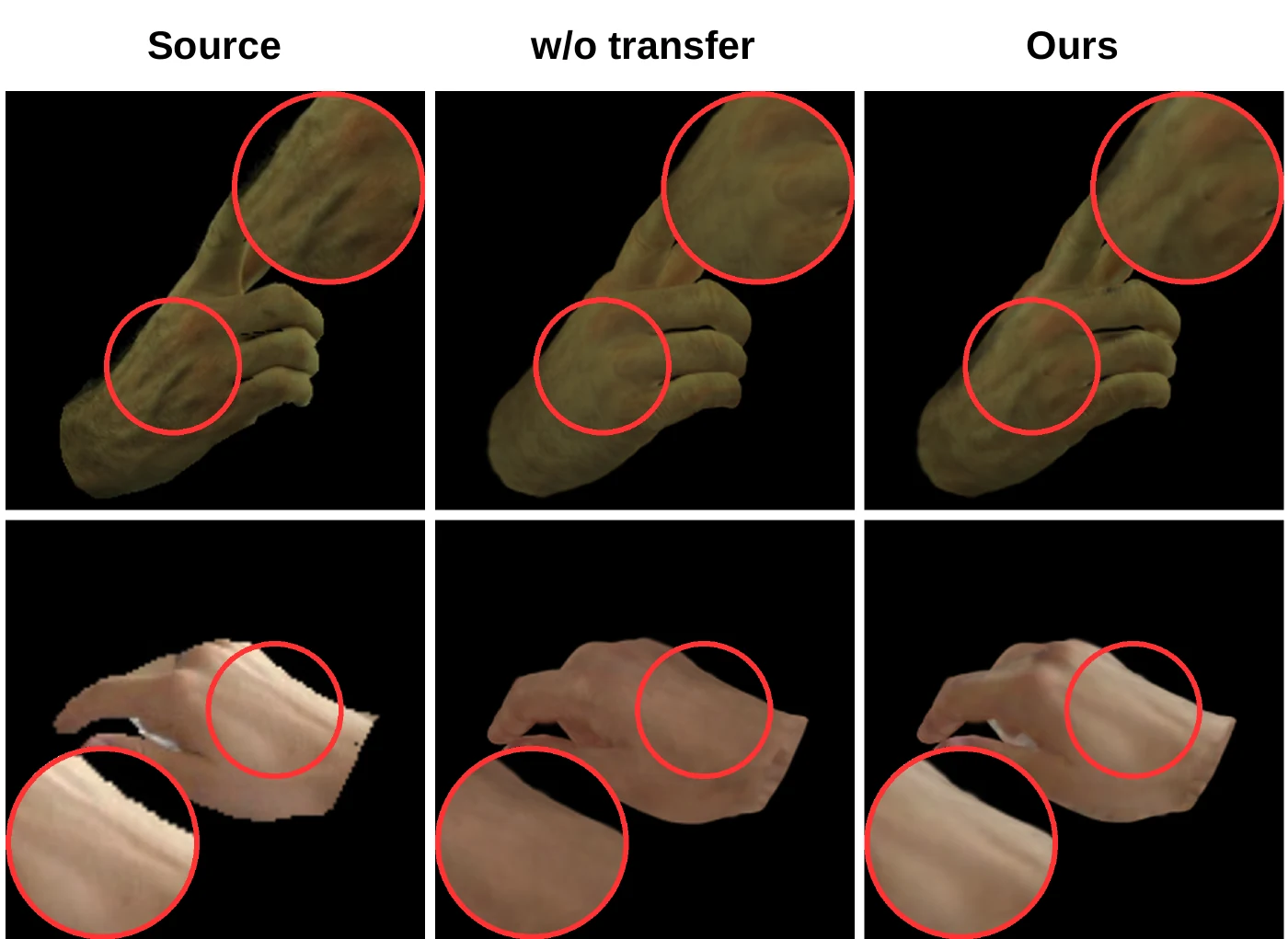
Reliability-gated Appearance Transfer
- Colors regressed from image features drift toward the learned prior, even where the hand is observed.
- Each Gaussian's rendering contribution in the source view, supported by the mask, serves as its reliability.
- Well-observed Gaussians take color from the source; the rest are completed from the learned prior and a global source identity. Geometry is untouched.
- In the source view, this raises PSNR by 1.96 dB on InterHand2.6M and by 3.41 dB on zero-shot HanCo.
BibTeX
@inproceedings{kim2026instanthand,
  title     = {{InstantHand}: Feed-Forward {3D} {Gaussian} Splatting for Animatable Hand Avatar Reconstruction from a Single Image},
  author    = {Kim, Chanho and Ali, Muhammad Salman and Gwak, Kyeonghwan and Shaheryar, Muhammad and Park, Incheol and On, Jeongwan and Baek, Seungryul},
  booktitle = {Advances in Neural Information Processing Systems (NeurIPS)},
  year      = {2026}
}